Bangladesh's UNESCO World Heritage Sites: A Cultural Journey
April 27, 2026
|
unesco
heritage
paharpur
bagerhat
history
<h2>Three Sites, Three Thousand Years of History</h2>
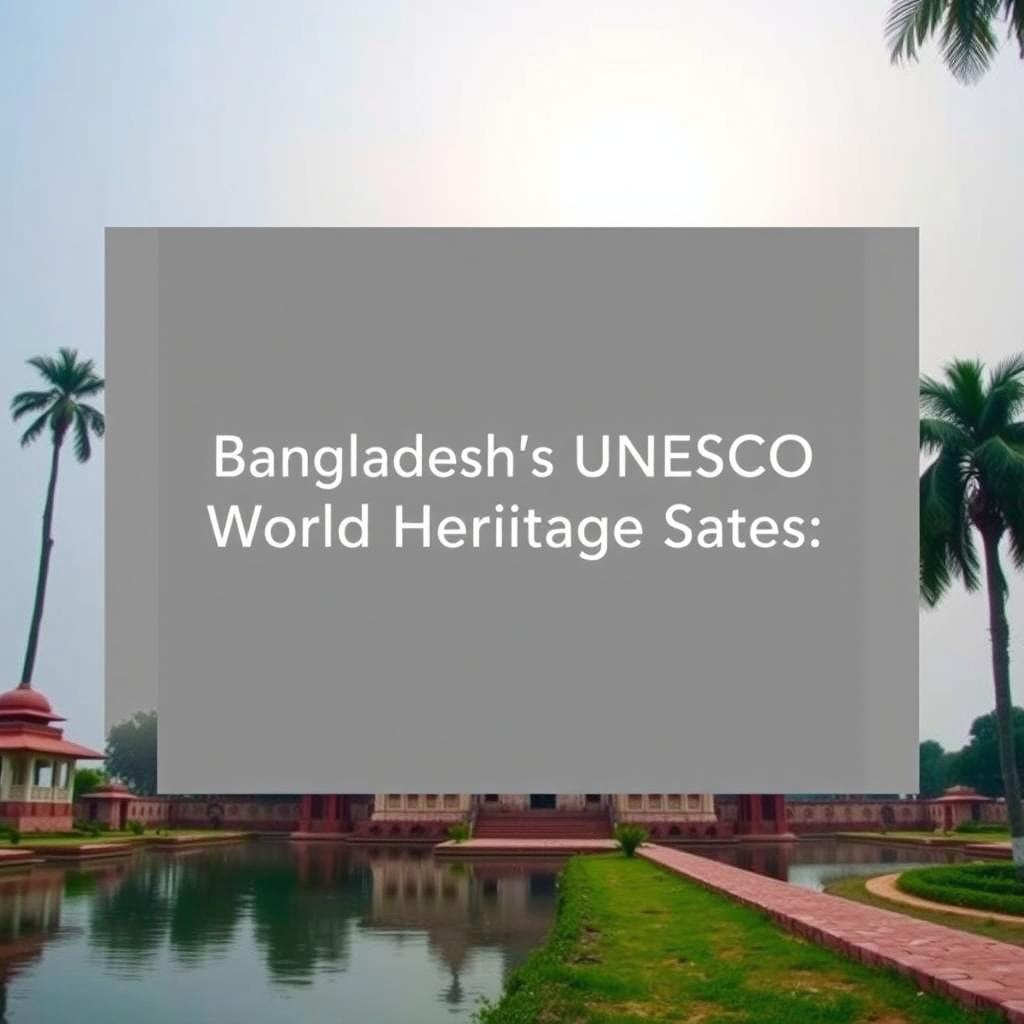
<p>Bangladesh possesses three UNESCO World Heritage Sites that together span nearly three millennia of human civilization in the Bengal delta. From the 8th-century Buddhist monastery of Paharpur in the north, to the 15th-century Islamic architectural marvel of Bagerhat in the south, to the timeless natural wonder of the Sundarbans mangrove forest — these sites represent the extraordinary cultural and natural heritage of one of the world's most historically layered regions.</p>
<p>For international travelers, these sites offer a compelling reason to visit Bangladesh beyond its beaches and hill tracts. For Bangladeshi travelers, they provide a tangible connection to the civilizations that shaped the land they live on. All three sites are accessible by road from Dhaka within 4-6 hours, making a comprehensive heritage tour feasible within a week.</p>
<h2>Somapura Mahavihara, Paharpur: The Great Monastery</h2>
<p>In the flat agricultural landscape of Naogaon district, the ruins of Somapura Mahavihara rise dramatically from the paddy fields — a cruciform structure covering 11 hectares that was, in its 8th-century prime, one of the largest Buddhist monasteries in the world. Founded by Dharmapala of the Pala dynasty around 781 CE, the monastery housed up to 1,000 monks and served as a center of Buddhist learning that influenced architecture and scholarship across Southeast Asia.</p>
<p>The central temple, rising 21 meters above the surrounding courtyard, is a terraced pyramid structure with ornamental terracotta panels depicting Buddhist, Hindu, and Jain scenes — a reflection of the religious pluralism that characterized the Pala period. The 177 individual monastic cells arranged around the courtyard give a vivid sense of the community that lived and studied here for over 400 years before the monastery was destroyed, likely by fire, in the 11th century.</p>
<p>The on-site museum displays terracotta plaques, bronze statues, coins, and everyday objects recovered from excavations. Entry costs ৳20 for Bangladeshis and ৳200 for foreigners. A knowledgeable guide — available at the entrance for ৳200-500 — transforms the visit from looking at old walls to understanding a living, breathing medieval institution.</p>
<p>Getting to Paharpur requires traveling to Naogaon (buses from Dhaka's Mohakhali terminal, 6-7 hours, ৳500-800) and then a local bus or CNG to the site 30 kilometers south. Accommodation in Naogaon is limited to basic hotels at ৳500-1,500 per night. Alternatively, stay in Rajshahi, 80 kilometers south, which has better hotels and additional attractions including the Varendra Research Museum — Bangladesh's oldest museum with an exceptional collection of Hindu and Buddhist sculptures.</p>
<h2>The Mosque City of Bagerhat: Khan Jahan Ali's Legacy</h2>
<p>Bagerhat, in the southwestern division of Khulna, contains the ruins of the historic city of Khalifatabad — a 15th-century planned urban center built by the Turkish general Khan Jahan Ali. The site encompasses 360 mosques, mausoleums, bridges, roads, and water management infrastructure scattered across approximately 50 square kilometers of suburban and rural landscape.</p>
<p>The crown jewel is the Shait Gumbad Mosque, also known as the Sixty Dome Mosque — though it actually has 77 domes covering a vast prayer hall supported by 60 stone pillars. Built entirely of brick, the mosque is the largest surviving medieval mosque in Bangladesh and a masterpiece of Sultanate-era architecture. The acoustics are remarkable: a speaker at the mihrab can be heard clearly throughout the entire hall without amplification, a feat of engineering that continues to impress modern architects.</p>
<p>Around the Sixty Dome Mosque, scattered through the town of Bagerhat and surrounding villages, are dozens of other historic structures. The single-domed Nine Dome Mosque, the Khan Jahan Ali mausoleum with its sacred pond of crocodiles — yes, actual crocodiles that have been fed and protected for centuries — the Bibi Begni Mosque, and numerous ancient tanks and bridges create an open-air architectural museum that rewards exploratory walking.</p>
<p>Entry to the Sixty Dome Mosque is ৳20 for Bangladeshis and ৳200 for foreigners. Other structures within the historic city are free to visit. Bagerhat is 175 kilometers from Dhaka via the Padma Bridge, now reachable in 3-4 hours by road. From Khulna, Bagerhat is just 25 kilometers away. Combine a Bagerhat visit with a Sundarbans trip from Khulna for a comprehensive southwestern Bangladesh itinerary.</p>
<h2>The Sundarbans: Nature's World Heritage</h2>
<p>The Sundarbans, inscribed as a World Heritage Site in 1997, is Bangladesh's only natural heritage site and the world's largest contiguous mangrove forest. Unlike the archaeological sites of Paharpur and Bagerhat, the Sundarbans is a living, breathing ecosystem that changes with every tide.</p>
<p>The UNESCO inscription recognizes the Sundarbans for its outstanding universal value on multiple criteria: it represents an ongoing ecological process of delta formation and tidal influence; it contains significant habitats for conservation of biological diversity including the endangered Royal Bengal Tiger; and its unique mangrove ecosystem, adapted to extreme salinity and tidal conditions, is of exceptional scientific interest.</p>
<p>Visiting the Sundarbans is covered in detail in our separate Sundarbans guide, but key points for heritage travelers: the Forest Department manages all access through a permit system, tours must be arranged through licensed operators, and the minimum meaningful visit is 2 days and 1 night to penetrate beyond the peripheral channels into the forest's interior where wildlife viewing is most rewarding.</p>
<h2>Planning a Heritage Circuit</h2>
<p>A comprehensive tour of all three UNESCO sites can be completed in 7-8 days from Dhaka. The most efficient itinerary: fly or bus to Rajshahi, visit Paharpur and spend a day exploring Rajshahi's own attractions including the Varendra Museum and Puthia Temple Complex. Continue south to Khulna, visit Bagerhat's Sixty Dome Mosque and surrounding monuments. Take a 2-3 day Sundarbans cruise from Mongla or Khulna. Return to Dhaka via the Padma Bridge.</p>
<p>Budget for this 7-day heritage circuit: ৳25,000-40,000 per person including transport, accommodation, meals, guides, and the Sundarbans cruise. Premium travelers spending more on accommodation and the Sundarbans cruise should budget ৳60,000-100,000. These costs are remarkably low by international heritage tourism standards — a comparable 7-day UNESCO site tour in neighboring India or Southeast Asia would cost 3-5 times more.</p>
<h2>Tentative UNESCO Sites: The Next Generation</h2>
<p>Bangladesh has 6 additional sites on the UNESCO Tentative List, awaiting full inscription. The Lalbagh Fort in Dhaka, a 17th-century Mughal fort with exquisite architecture, is perhaps the most likely next inscription. Mahasthangarh in Bogura, the oldest known urban archaeological site in Bangladesh dating to the 3rd century BCE, represents the earliest city in the Bengal region. The ancient Buddhist monastery of Mainamati in Comilla, the historic mosques of Dhaka, Halud Vihara in Naogaon, and the Sundarbans' extension to include the Indian portion are all under consideration.</p>
<p>For travelers interested in archaeology and history, visiting these tentative sites alongside the three inscribed sites provides a comprehensive picture of Bengal's civilizational journey — from the 3rd-century BCE urban planning of Mahasthangarh through the Buddhist scholarship of Paharpur, the Islamic architecture of Bagerhat, and the Mughal grandeur of Lalbagh Fort. Few countries pack so much historical diversity into such a compact geography.</p>
<p>Bangladesh possesses three UNESCO World Heritage Sites that together span nearly three millennia of human civilization in the Bengal delta. From the 8th-century Buddhist monastery of Paharpur in the north, to the 15th-century Islamic architectural marvel of Bagerhat in the south, to the timeless natural wonder of the Sundarbans mangrove forest — these sites represent the extraordinary cultural and natural heritage of one of the world's most historically layered regions.</p>
<p>For international travelers, these sites offer a compelling reason to visit Bangladesh beyond its beaches and hill tracts. For Bangladeshi travelers, they provide a tangible connection to the civilizations that shaped the land they live on. All three sites are accessible by road from Dhaka within 4-6 hours, making a comprehensive heritage tour feasible within a week.</p>
<h2>Somapura Mahavihara, Paharpur: The Great Monastery</h2>
<p>In the flat agricultural landscape of Naogaon district, the ruins of Somapura Mahavihara rise dramatically from the paddy fields — a cruciform structure covering 11 hectares that was, in its 8th-century prime, one of the largest Buddhist monasteries in the world. Founded by Dharmapala of the Pala dynasty around 781 CE, the monastery housed up to 1,000 monks and served as a center of Buddhist learning that influenced architecture and scholarship across Southeast Asia.</p>
<p>The central temple, rising 21 meters above the surrounding courtyard, is a terraced pyramid structure with ornamental terracotta panels depicting Buddhist, Hindu, and Jain scenes — a reflection of the religious pluralism that characterized the Pala period. The 177 individual monastic cells arranged around the courtyard give a vivid sense of the community that lived and studied here for over 400 years before the monastery was destroyed, likely by fire, in the 11th century.</p>
<p>The on-site museum displays terracotta plaques, bronze statues, coins, and everyday objects recovered from excavations. Entry costs ৳20 for Bangladeshis and ৳200 for foreigners. A knowledgeable guide — available at the entrance for ৳200-500 — transforms the visit from looking at old walls to understanding a living, breathing medieval institution.</p>
<p>Getting to Paharpur requires traveling to Naogaon (buses from Dhaka's Mohakhali terminal, 6-7 hours, ৳500-800) and then a local bus or CNG to the site 30 kilometers south. Accommodation in Naogaon is limited to basic hotels at ৳500-1,500 per night. Alternatively, stay in Rajshahi, 80 kilometers south, which has better hotels and additional attractions including the Varendra Research Museum — Bangladesh's oldest museum with an exceptional collection of Hindu and Buddhist sculptures.</p>
<h2>The Mosque City of Bagerhat: Khan Jahan Ali's Legacy</h2>
<p>Bagerhat, in the southwestern division of Khulna, contains the ruins of the historic city of Khalifatabad — a 15th-century planned urban center built by the Turkish general Khan Jahan Ali. The site encompasses 360 mosques, mausoleums, bridges, roads, and water management infrastructure scattered across approximately 50 square kilometers of suburban and rural landscape.</p>
<p>The crown jewel is the Shait Gumbad Mosque, also known as the Sixty Dome Mosque — though it actually has 77 domes covering a vast prayer hall supported by 60 stone pillars. Built entirely of brick, the mosque is the largest surviving medieval mosque in Bangladesh and a masterpiece of Sultanate-era architecture. The acoustics are remarkable: a speaker at the mihrab can be heard clearly throughout the entire hall without amplification, a feat of engineering that continues to impress modern architects.</p>
<p>Around the Sixty Dome Mosque, scattered through the town of Bagerhat and surrounding villages, are dozens of other historic structures. The single-domed Nine Dome Mosque, the Khan Jahan Ali mausoleum with its sacred pond of crocodiles — yes, actual crocodiles that have been fed and protected for centuries — the Bibi Begni Mosque, and numerous ancient tanks and bridges create an open-air architectural museum that rewards exploratory walking.</p>
<p>Entry to the Sixty Dome Mosque is ৳20 for Bangladeshis and ৳200 for foreigners. Other structures within the historic city are free to visit. Bagerhat is 175 kilometers from Dhaka via the Padma Bridge, now reachable in 3-4 hours by road. From Khulna, Bagerhat is just 25 kilometers away. Combine a Bagerhat visit with a Sundarbans trip from Khulna for a comprehensive southwestern Bangladesh itinerary.</p>
<h2>The Sundarbans: Nature's World Heritage</h2>
<p>The Sundarbans, inscribed as a World Heritage Site in 1997, is Bangladesh's only natural heritage site and the world's largest contiguous mangrove forest. Unlike the archaeological sites of Paharpur and Bagerhat, the Sundarbans is a living, breathing ecosystem that changes with every tide.</p>
<p>The UNESCO inscription recognizes the Sundarbans for its outstanding universal value on multiple criteria: it represents an ongoing ecological process of delta formation and tidal influence; it contains significant habitats for conservation of biological diversity including the endangered Royal Bengal Tiger; and its unique mangrove ecosystem, adapted to extreme salinity and tidal conditions, is of exceptional scientific interest.</p>
<p>Visiting the Sundarbans is covered in detail in our separate Sundarbans guide, but key points for heritage travelers: the Forest Department manages all access through a permit system, tours must be arranged through licensed operators, and the minimum meaningful visit is 2 days and 1 night to penetrate beyond the peripheral channels into the forest's interior where wildlife viewing is most rewarding.</p>
<h2>Planning a Heritage Circuit</h2>
<p>A comprehensive tour of all three UNESCO sites can be completed in 7-8 days from Dhaka. The most efficient itinerary: fly or bus to Rajshahi, visit Paharpur and spend a day exploring Rajshahi's own attractions including the Varendra Museum and Puthia Temple Complex. Continue south to Khulna, visit Bagerhat's Sixty Dome Mosque and surrounding monuments. Take a 2-3 day Sundarbans cruise from Mongla or Khulna. Return to Dhaka via the Padma Bridge.</p>
<p>Budget for this 7-day heritage circuit: ৳25,000-40,000 per person including transport, accommodation, meals, guides, and the Sundarbans cruise. Premium travelers spending more on accommodation and the Sundarbans cruise should budget ৳60,000-100,000. These costs are remarkably low by international heritage tourism standards — a comparable 7-day UNESCO site tour in neighboring India or Southeast Asia would cost 3-5 times more.</p>
<h2>Tentative UNESCO Sites: The Next Generation</h2>
<p>Bangladesh has 6 additional sites on the UNESCO Tentative List, awaiting full inscription. The Lalbagh Fort in Dhaka, a 17th-century Mughal fort with exquisite architecture, is perhaps the most likely next inscription. Mahasthangarh in Bogura, the oldest known urban archaeological site in Bangladesh dating to the 3rd century BCE, represents the earliest city in the Bengal region. The ancient Buddhist monastery of Mainamati in Comilla, the historic mosques of Dhaka, Halud Vihara in Naogaon, and the Sundarbans' extension to include the Indian portion are all under consideration.</p>
<p>For travelers interested in archaeology and history, visiting these tentative sites alongside the three inscribed sites provides a comprehensive picture of Bengal's civilizational journey — from the 3rd-century BCE urban planning of Mahasthangarh through the Buddhist scholarship of Paharpur, the Islamic architecture of Bagerhat, and the Mughal grandeur of Lalbagh Fort. Few countries pack so much historical diversity into such a compact geography.</p>
