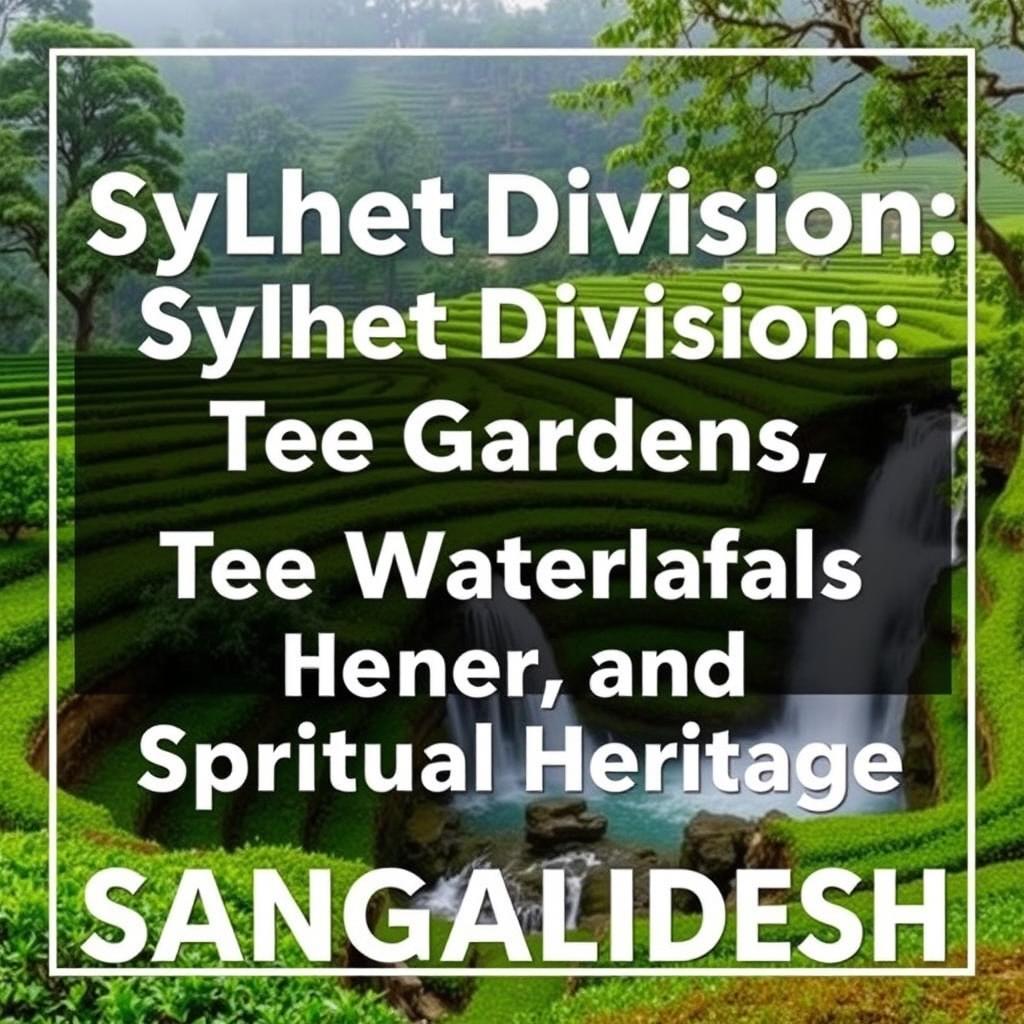
Sylhet Division: Tea Gardens, Waterfalls, and Spiritual Heritage
April 22, 2026
|
sylhet
tea-garden
waterfall
haor
spiritual
<h2>The Green Heart of Bangladesh</h2>
<p>Sylhet division, in Bangladesh's northeast corner, is a world apart from the flat deltaic landscape that defines most of the country. Here, undulating hills carpeted with tea gardens stretch to the horizon, waterfalls cascade through ancient forests, haor wetlands teem with migratory birds, and the spiritual heritage of Sufi saints draws millions of pilgrims annually. It's arguably Bangladesh's most diverse travel region, offering radically different experiences within an area you can cross in a few hours.</p>
<p>The region has deep connections to the Bangladeshi diaspora — a significant portion of British Bangladeshis trace their roots to Sylhet, and many return regularly, creating a unique tourism dynamic where cultural homecoming and leisure travel intersect. This diaspora connection has also driven infrastructure development: Osmani International Airport in Sylhet city receives regular international flights from London, making the region directly accessible from the UK.</p>
<h2>Sreemangal: The Tea Capital</h2>
<p>Sreemangal, a small town in Moulvibazar district, is surrounded by Bangladesh's largest concentration of tea gardens — 160 estates producing 85% of the country's tea. The landscape is extraordinarily photogenic: symmetrical rows of waist-high tea bushes in every shade of green, punctuated by shade trees and the colorful figures of tea pluckers — mostly women from the Adivasi tea community — filling their baskets with the characteristic "two leaves and a bud" that produce fine quality tea.</p>
<p>The best way to experience the tea gardens is on foot or by bicycle. Several estates welcome visitors, though it's polite to ask at the estate office before wandering through the gardens. The Finlay tea estate, Lackaturah, and Zareen tea gardens are among the most accessible and picturesque. During peak plucking season from March to November, you can watch the entire process from field to factory — plucking, withering, rolling, oxidation, drying, and sorting — at estate factories that occasionally open for visitors.</p>
<p>Sreemangal is also home to the Lawachara National Park, a 1,250-hectare tropical semi-evergreen forest that's one of Bangladesh's most accessible wildlife viewing destinations. The park shelters the endangered hoolock gibbon — South Asia's only ape species — along with capped langurs, barking deer, and over 240 bird species. Guided walks cost ৳200-300 and typically last 2-3 hours. Early morning visits between 6-8 AM offer the best chance of hearing the gibbons' distinctive calls echoing through the forest canopy.</p>
<h2>Jaflong and Ratargul: Stone Country and Swamp Forest</h2>
<p>Jaflong, on the Indian border 60 kilometers from Sylhet city, is where the Piyain River emerges from the Khasi Hills of Meghalaya carrying tons of crystal-clear water and river stones. The landscape is striking: a wide river bed of smooth, rounded stones in grays, whites, and greens, backed by the dramatic wall of the Khasi Hills rising into cloud on the Indian side. Stone collection from the river — a controversial industry that employs thousands but causes environmental damage — adds an industrial dimension to the natural beauty.</p>
<p>The Dawki River, visible from Jaflong during the dry season, is famous for water so transparent that boats appear to float on air — photos from the Indian side of this river have gone viral globally. While the Bangladeshi side offers less dramatic photo opportunities, the clarity of the water and the stunning hillside backdrop make Jaflong one of the country's most visually spectacular destinations.</p>
<p>Ratargul Swamp Forest, 26 kilometers from Sylhet city near Gowainghat, is Bangladesh's only freshwater swamp forest and one of only a handful in the world. During the monsoon from June to October, the forest floods to depths of 6-10 feet, and visitors explore by boat through a surreal underwater forest where tree trunks emerge from dark water, lianas hang overhead, and silence is broken only by bird calls. It's been called the "Amazon of Bangladesh" — an exaggeration in scale but not in atmosphere. Country boat rental costs ৳500-1,000 for a 2-hour tour.</p>
<h2>Spiritual Heritage: The Shrines of Sylhet</h2>
<p>Sylhet's spiritual significance in South Asian Islam is immense. Hazrat Shah Jalal's dargah in Sylhet city is one of the most visited shrines in the subcontinent. The 14th-century Sufi saint is credited with bringing Islam to the Sylhet region, and his mausoleum complex — with its sacred pond of catfish, ancient mosque, and the perpetual flame said to burn since Shah Jalal's time — draws 50,000+ visitors during annual Urs celebrations.</p>
<p>Hazrat Shah Paran's shrine in nearby Khadim Nagar is another major pilgrimage site, set in forested hills with a natural beauty that complements its spiritual atmosphere. The shrine of Hazrat Shah Kamal in Shahporan area, the ancient mosques of Mughal-era Sylhet, and the Hindu temples that reflect the region's diverse religious heritage together create a spiritual landscape that rewards contemplative travelers of all faiths or none.</p>
<h2>Haor Country: Bangladesh's Inland Sea</h2>
<p>The haors of Sylhet division — vast, seasonally flooded wetlands — create landscapes that defy expectation. During the monsoon, haors like Tanguar Haor and Hakaluki Haor become inland seas stretching to the horizon, with villages accessible only by boat perched on raised mounds. During the dry season, they transform into fertile agricultural land where boro rice cultivation produces much of Bangladesh's food.</p>
<p>Tanguar Haor, a Ramsar Wetland of International Importance, is a birdwatcher's paradise during winter months when migratory species from Siberia and Central Asia arrive in their hundreds of thousands. Cormorants, teals, pochards, shovelers, and the rare Pallas's fish eagle are among the species regularly spotted. Community-based tourism initiatives allow visitors to stay overnight in fishing villages within the haor, experiencing a way of life that has remained largely unchanged for centuries. A 2-day haor tour from Sunamganj costs ৳3,000-6,000 per person including boat, meals, and guide.</p>
<p>Getting to Sylhet is easy. Daily flights from Dhaka take 45 minutes and cost ৳3,000-5,000 one way. The Dhaka-Sylhet train takes 6-7 hours and costs ৳350-800 depending on class. Buses from Dhaka take 4-5 hours on the new expressway and cost ৳500-900. Within Sylhet division, local buses, CNGs, and hired cars connect all major destinations.</p>
<p>Sylhet division, in Bangladesh's northeast corner, is a world apart from the flat deltaic landscape that defines most of the country. Here, undulating hills carpeted with tea gardens stretch to the horizon, waterfalls cascade through ancient forests, haor wetlands teem with migratory birds, and the spiritual heritage of Sufi saints draws millions of pilgrims annually. It's arguably Bangladesh's most diverse travel region, offering radically different experiences within an area you can cross in a few hours.</p>
<p>The region has deep connections to the Bangladeshi diaspora — a significant portion of British Bangladeshis trace their roots to Sylhet, and many return regularly, creating a unique tourism dynamic where cultural homecoming and leisure travel intersect. This diaspora connection has also driven infrastructure development: Osmani International Airport in Sylhet city receives regular international flights from London, making the region directly accessible from the UK.</p>
<h2>Sreemangal: The Tea Capital</h2>
<p>Sreemangal, a small town in Moulvibazar district, is surrounded by Bangladesh's largest concentration of tea gardens — 160 estates producing 85% of the country's tea. The landscape is extraordinarily photogenic: symmetrical rows of waist-high tea bushes in every shade of green, punctuated by shade trees and the colorful figures of tea pluckers — mostly women from the Adivasi tea community — filling their baskets with the characteristic "two leaves and a bud" that produce fine quality tea.</p>
<p>The best way to experience the tea gardens is on foot or by bicycle. Several estates welcome visitors, though it's polite to ask at the estate office before wandering through the gardens. The Finlay tea estate, Lackaturah, and Zareen tea gardens are among the most accessible and picturesque. During peak plucking season from March to November, you can watch the entire process from field to factory — plucking, withering, rolling, oxidation, drying, and sorting — at estate factories that occasionally open for visitors.</p>
<p>Sreemangal is also home to the Lawachara National Park, a 1,250-hectare tropical semi-evergreen forest that's one of Bangladesh's most accessible wildlife viewing destinations. The park shelters the endangered hoolock gibbon — South Asia's only ape species — along with capped langurs, barking deer, and over 240 bird species. Guided walks cost ৳200-300 and typically last 2-3 hours. Early morning visits between 6-8 AM offer the best chance of hearing the gibbons' distinctive calls echoing through the forest canopy.</p>
<h2>Jaflong and Ratargul: Stone Country and Swamp Forest</h2>
<p>Jaflong, on the Indian border 60 kilometers from Sylhet city, is where the Piyain River emerges from the Khasi Hills of Meghalaya carrying tons of crystal-clear water and river stones. The landscape is striking: a wide river bed of smooth, rounded stones in grays, whites, and greens, backed by the dramatic wall of the Khasi Hills rising into cloud on the Indian side. Stone collection from the river — a controversial industry that employs thousands but causes environmental damage — adds an industrial dimension to the natural beauty.</p>
<p>The Dawki River, visible from Jaflong during the dry season, is famous for water so transparent that boats appear to float on air — photos from the Indian side of this river have gone viral globally. While the Bangladeshi side offers less dramatic photo opportunities, the clarity of the water and the stunning hillside backdrop make Jaflong one of the country's most visually spectacular destinations.</p>
<p>Ratargul Swamp Forest, 26 kilometers from Sylhet city near Gowainghat, is Bangladesh's only freshwater swamp forest and one of only a handful in the world. During the monsoon from June to October, the forest floods to depths of 6-10 feet, and visitors explore by boat through a surreal underwater forest where tree trunks emerge from dark water, lianas hang overhead, and silence is broken only by bird calls. It's been called the "Amazon of Bangladesh" — an exaggeration in scale but not in atmosphere. Country boat rental costs ৳500-1,000 for a 2-hour tour.</p>
<h2>Spiritual Heritage: The Shrines of Sylhet</h2>
<p>Sylhet's spiritual significance in South Asian Islam is immense. Hazrat Shah Jalal's dargah in Sylhet city is one of the most visited shrines in the subcontinent. The 14th-century Sufi saint is credited with bringing Islam to the Sylhet region, and his mausoleum complex — with its sacred pond of catfish, ancient mosque, and the perpetual flame said to burn since Shah Jalal's time — draws 50,000+ visitors during annual Urs celebrations.</p>
<p>Hazrat Shah Paran's shrine in nearby Khadim Nagar is another major pilgrimage site, set in forested hills with a natural beauty that complements its spiritual atmosphere. The shrine of Hazrat Shah Kamal in Shahporan area, the ancient mosques of Mughal-era Sylhet, and the Hindu temples that reflect the region's diverse religious heritage together create a spiritual landscape that rewards contemplative travelers of all faiths or none.</p>
<h2>Haor Country: Bangladesh's Inland Sea</h2>
<p>The haors of Sylhet division — vast, seasonally flooded wetlands — create landscapes that defy expectation. During the monsoon, haors like Tanguar Haor and Hakaluki Haor become inland seas stretching to the horizon, with villages accessible only by boat perched on raised mounds. During the dry season, they transform into fertile agricultural land where boro rice cultivation produces much of Bangladesh's food.</p>
<p>Tanguar Haor, a Ramsar Wetland of International Importance, is a birdwatcher's paradise during winter months when migratory species from Siberia and Central Asia arrive in their hundreds of thousands. Cormorants, teals, pochards, shovelers, and the rare Pallas's fish eagle are among the species regularly spotted. Community-based tourism initiatives allow visitors to stay overnight in fishing villages within the haor, experiencing a way of life that has remained largely unchanged for centuries. A 2-day haor tour from Sunamganj costs ৳3,000-6,000 per person including boat, meals, and guide.</p>
<p>Getting to Sylhet is easy. Daily flights from Dhaka take 45 minutes and cost ৳3,000-5,000 one way. The Dhaka-Sylhet train takes 6-7 hours and costs ৳350-800 depending on class. Buses from Dhaka take 4-5 hours on the new expressway and cost ৳500-900. Within Sylhet division, local buses, CNGs, and hired cars connect all major destinations.</p>
